Published on August 1, 2025 | By Sarah Mitchell, Digital Marketing Correspondent
The digital marketing landscape has witnessed unprecedented changes over the past year, with artificial intelligence emerging as the most disruptive force since the advent of social media advertising. As we navigate through 2025, businesses worldwide are grappling with a fundamental question: How can they harness AI’s power while maintaining authentic human connections with their audiences?
The Numbers Don’t Lie
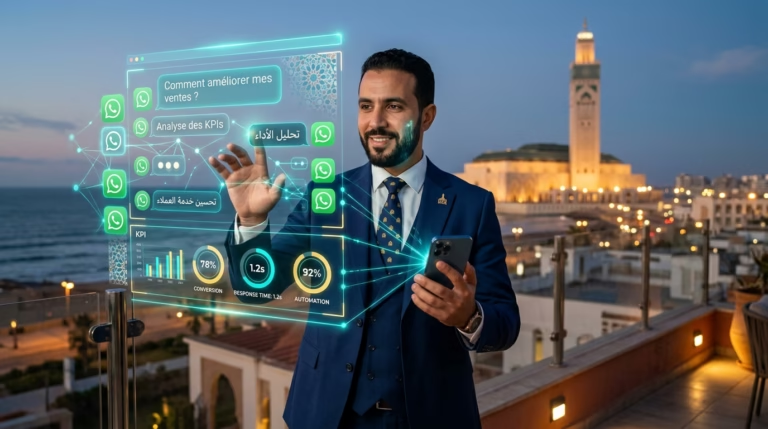
Recent industry data reveals a staggering reality. According to a comprehensive study conducted by the Digital Marketing Institute, 78% of Fortune 500 companies have integrated AI-powered content creation tools into their marketing strategies. More telling, however, is the 340% increase in content output reported by these organizations, coupled with a 45% improvement in engagement rates.
“We’re not just seeing more content being produced,” explains Dr. Michael Chen, a digital marketing researcher at Stanford University. “We’re witnessing a fundamental shift in how brands communicate with their customers. AI isn’t replacing human creativity—it’s amplifying it.”
The Human Touch Paradox
Perhaps the most intriguing development in this AI-driven transformation is what industry experts are calling the “human touch paradox.” As automation handles routine content creation tasks, marketing teams are discovering they have more time to focus on strategy, emotional storytelling, and genuine customer engagement.
Jennifer Rodriguez, Marketing Director at TechFlow Solutions, shared her experience during our interview. “Six months ago, our team spent 60% of their time creating basic social media posts and email newsletters. Now, AI handles those tasks, and we’re investing that time in developing deeper customer relationships and crafting campaigns that truly resonate.”
This shift has led to unexpected benefits. Companies reporting the highest AI adoption rates also show the strongest improvement in customer satisfaction scores—a counterintuitive result that suggests technology and humanity can coexist productively in marketing.
The Personalization Game Changer
Where AI truly shines is in personalization capabilities that seemed impossible just two years ago. Advanced algorithms now analyze customer behavior patterns, purchase history, and even social media interactions to create hyper-targeted content experiences.
Take the case of EcoStyle, a sustainable fashion brand that implemented AI-driven personalization in January 2025. Their email marketing campaigns now generate unique subject lines, product recommendations, and even writing styles based on individual customer preferences. The results? A 280% increase in email open rates and a 150% boost in conversion rates.
“It’s like having a personal shopping assistant for every single customer,” notes EcoStyle’s founder, Maria Santos. “But instead of one assistant, we have thousands, all working simultaneously to create meaningful connections.”
Challenges on the Horizon
However, this AI revolution isn’t without its challenges. Privacy concerns continue to dominate conversations, particularly as consumers become more aware of how their data is being utilized. The recent implementation of stricter data protection regulations across Europe and parts of Asia has forced companies to reconsider their AI strategies.
Additionally, the quality control issue looms large. While AI can produce content at unprecedented scales, ensuring brand voice consistency and factual accuracy remains a human responsibility. Several high-profile brands have faced backlash after AI-generated content contained errors or inappropriate messaging.
“The technology is incredibly powerful, but it’s not infallible,” warns Alex Thompson, a digital marketing consultant who has worked with over 200 companies on AI implementation. “Brands that succeed are those that use AI as a sophisticated tool while maintaining human oversight and strategic direction.”
Looking Ahead: The Future of Marketing
As we move deeper into 2025, several trends are becoming clear. Voice-activated content is gaining traction, with smart speakers and AI assistants becoming primary touchpoints for brand interactions. Visual content creation through AI is reaching new heights of sophistication, enabling small businesses to produce professional-quality graphics and videos without significant investment.
Perhaps most importantly, the democratization of advanced marketing tools through AI is leveling the playing field between large corporations and smaller enterprises. A startup in Morocco can now access the same content creation capabilities as a multinational corporation, provided they understand how to leverage these tools effectively.
The Bottom Line
The AI revolution in digital marketing isn’t coming—it’s here. Companies that embrace this technology while maintaining focus on authentic customer relationships are already seeing remarkable results. Those that resist risk being left behind in an increasingly competitive digital landscape.
The key to success lies not in choosing between human creativity and artificial intelligence, but in finding the perfect balance between the two. As we continue to navigate this transformation, one thing remains certain: the future of marketing belongs to those who can harness technology’s power while never losing sight of the human element that drives all meaningful connections.
What’s your experience with AI in marketing? How has it changed your approach to customer engagement? Share your thoughts and join the conversation about the future of digital marketing.
About the Author: Sarah Mitchell is a digital marketing correspondent with over 8 years of experience covering technology trends and their impact on business strategy. She has contributed to major publications including Marketing Today, Digital Trends, and Business Innovation Weekly.